January 19, 2026
What is Revenue Management Software? (And Why Excel Isn't Enough in 2026)
Why Revenue Management Software is Essential - Say Goodbye to Excel in 2026
Learn why revenue management software is essential in 2026 and why Excel is no longer sufficient. Upgrade to revenue management software for better results.
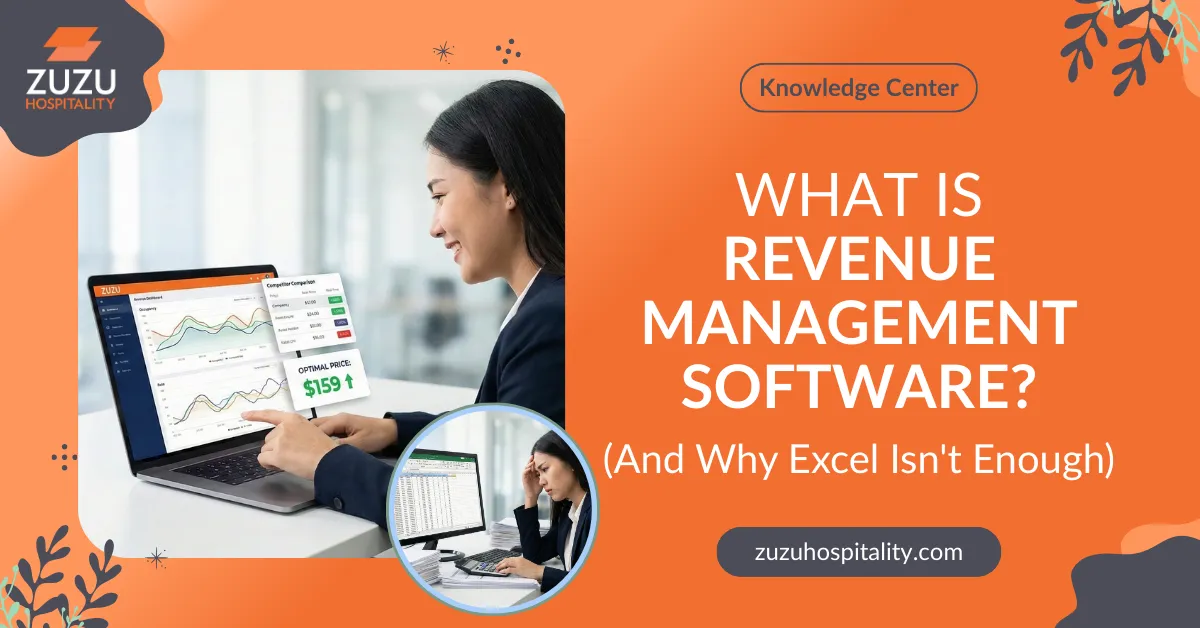
For decades, hotel revenue managers have relied on one tool above all others: Microsoft Excel. While spreadsheets are excellent for basic calculations, using them to manage hotel pricing in 2026 is like navigating with a paper map when everyone else has GPS.
Revenue Management Software (RMS) is an intelligent system that uses algorithms and AI to analyze historical data, market conditions, and consumer demand to calculate optimal pricing for your rooms in real-time. Unlike Excel, which requires manual data entry and updates, modern RMS tools process vast amounts of data instantly to provide comprehensive market insights. [1][2]
According to recent industry data, hotels switching to RMS typically see 15-20% increases in RevPAR, yet only 28% of hotels currently use these tools — representing a significant competitive advantage for early adopters. [3][4]
The Real Cost of Excel: Beyond "Free"
Many independent hoteliers stick with Excel because it appears free. However, the hidden costs are substantial:
Time Investment
Revenue managers spend significant time on repetitive tasks:
- Collecting data from multiple OTA extranets
- Manually updating competitor rate sheets
- Calculating demand forecasts
- Adjusting rates across channels
Industry benchmark: Hotels using RMS save 20-40 hours per month on these manual workflows. [5][6] That's time that could be spent on strategy, guest experience, or property improvements.
The Error Problem
Research by Professor Raymond Panko from the University of Hawaii found that 88% of spreadsheets contain errors. [7][8] Field audits of operational spreadsheets show an average cell error rate of 5.2% — meaning in a spreadsheet with 200 formulas, you can expect about 10 errors. [9]
These aren't just typos. Common errors include:
- Incorrect cell references in formulas
- Data omitted from calculations
- Copy-paste mistakes that cascade through linked cells
- Outdated formulas that no longer reflect current strategy
One pricing error repeated across 30 days could mean thousands in lost revenue—or worse, pricing yourself out of the market entirely.
Reactive Instead of Proactive
Excel shows you what happened. It cannot predict what will happen or adjust to market changes automatically.
When a major event is announced in your area, competitors with RMS adjust pricing within hours. Excel users often discover these opportunities days later, missing the most valuable booking window.
Excel vs. Revenue Management Software: The Comparison
| Feature | Manual Spreadsheet (Excel) | Revenue Management Software (RMS) |
| Data Sources | Limited to what you manually input | Analyzes historical performance, competitor rates, market demand, local events, and economic indicators automatically [1][10] |
| Update Frequency | Once daily or weekly when you have time | Continuous, 24/7 real-time adjustments [11] |
| Decision Basis | Gut feeling, experience, limited data | Data-driven algorithms analyzing hundreds of demand signals [12] |
| Competitor Tracking | Manual checks on OTA sites | Automated monitoring with consolidated dashboard [13] |
| Forecasting | Basic averages or manual projections | AI-powered predictions with ~20% better accuracy than traditional methods [14] |
| Error Rate | 88% of spreadsheets contain errors [7][8] | Calculation errors nearly eliminated (algorithms don't make typos) |
| Scalability | Becomes unmanageable beyond 2-3 properties | Handles single properties to large portfolios seamlessly |
What Modern RMS Actually Does
A quality revenue management system provides capabilities that spreadsheets simply cannot match:
1. Dynamic Pricing
Automatically adjusts rates based on:
- Current and forecasted occupancy levels
- Booking pace and lead time patterns
- Competitor rate positioning
- Length of stay optimization
- Day-of-week and seasonal patterns
- Local events and demand drivers
Rates can update continuously as market conditions change, ensuring you're always competitively positioned. [15]
2. Demand Forecasting
Machine learning algorithms analyze booking patterns to predict future demand with greater accuracy. Hotels implementing ML-driven RMS in early 2025 achieved 15% revenue increases and notable improvements in off-peak season bookings. [16]
The system factors in:
- Historical booking curves
- Market trends and pace
- External events (conferences, festivals, weather)
- Competitor availability and pricing
3. Competitor Intelligence
Continuous monitoring of your competitive set shows:
- Real-time rate positioning across OTAs
- Availability and restrictions at competing properties
- Rate change alerts and trends
- Strategic positioning analysis [13]
This replaces hours of manual extranet checking with automated insights.
4. Performance Analytics
Track essential metrics without manual spreadsheet calculations:
- RevPAR (Revenue Per Available Room)
- ADR (Average Daily Rate)
- Occupancy percentage
- Pickup and pace analysis
- Channel performance and contribution
Data is presented in intuitive dashboards rather than complex Excel tabs. [17]
5. Integration Capabilities
Effective RMS integrates with your existing systems:
- PMS: Real-time occupancy and reservation data
- Channel Manager: Automatic rate distribution to 300+ OTAs
- Booking Engine: Direct channel optimization
- CRM: Guest behavior patterns
Without integration, you're back to manual data entry — defeating the purpose of automation. [18]
Industry Adoption and Results
The hotel industry is in the midst of a technology transformation:
Market Growth:
- The RMS market reached $16.41 billion in 2023 and is projected to grow to $29.43 billion by 2031 (8.7% CAGR) [19]
- This growth reflects increasing recognition that revenue optimization is essential, not optional
Current Adoption:
- Only 28% of hotels use RMS tools (Skift Research) [4]
- When excluding basic free tools, only 10% have advanced RMS [4]
- This means 72% of hotels still rely on manual methods
Documented Results:
- Hotels typically see 15-20% RevPAR increases after RMS adoption [3][20]
- Advanced implementations report up to 35% higher RevPAR [21]
- 83% of hotel investors rate RMS ROI as "high" or "very high" [22]
- 68% of hotels using RMS report fewer pricing errors [23]
Efficiency Gains:
- 20-40 hours saved monthly through automation [5][6]
- Revenue managers shift from data entry to strategic thinking
- Up to 50% reduction in routine workload (Gartner estimate) [24]
Understanding RMS Limitations: Software Isn't Magic
It's important to understand that RMS is a tool, not a complete solution by itself.
What Software Does Well:
- Process massive data sets instantly
- Identify patterns humans might miss
- Eliminate calculation errors
- Execute rules consistently
- Monitor markets continuously
What Software Struggles With:
- Understanding unique local context
- Recognizing unprecedented market shifts
- Balancing short-term optimization with long-term strategy
- Interpreting qualitative factors (reputation, guest satisfaction trends)
- Making judgment calls on incomplete information
The Reality: Many hotels purchase RMS but struggle with:
- Initial setup and configuration
- Ongoing optimization and rule refinement
- Strategic interpretation of recommendations
- Integrating insights into broader business strategy
This is why some RMS providers have evolved to offer hybrid models—combining software capabilities with human expertise to interpret data and provide strategic guidance.
Making the Switch: Practical Considerations
If you're considering moving from Excel to RMS, here's what to expect:
Implementation Timeline:
Weeks 1-2: System setup and data integration
- Connect to PMS, channel manager, and other systems
- Configure room types, rate plans, and pricing rules
- Import historical data
Weeks 3-4: Testing and optimization
- Validate rate calculations
- Refine pricing logic
- Train team on new system
Month 2+: Full operation and continuous improvement
- Monitor performance vs. baseline
- Adjust strategies based on results
- Expand use of advanced features
Cost Considerations:
RMS pricing typically ranges from $500-2,000+ monthly depending on:
- Property size and complexity
- Feature set and capabilities
- Level of support included
- Integration requirements
Compare this to the 20-40 hours monthly spent on manual revenue management. For a revenue manager earning $50,000/year, that's roughly $1,200-2,400/month in labor costs on tasks that could be automated.
Common Concerns:
"We're too small for RMS"
Many modern RMS platforms are designed specifically for independent and boutique properties. The time savings alone often justify the investment for properties with as few as 10-20 rooms.
"Our revenue manager knows the market better than software"
The goal isn't to replace human judgment but to enhance it. RMS handles data processing and calculation while humans provide strategy, context, and interpretation.
"Implementation seems complicated"
Cloud-based RMS requires no technical expertise. Most systems are designed for hoteliers, not IT professionals. Many vendors provide comprehensive onboarding and support.
Conclusion
Excel is a powerful tool — for what it was designed to do. But modern hotel revenue management requires capabilities that spreadsheets simply cannot provide:
- Real-time processing of multiple data sources
- Complex demand forecasting with hundreds of variables
- Continuous dynamic pricing adjustments
- Error-free calculations across thousands of scenarios
- Strategic insights backed by machine learning
The competitive landscape has evolved. Hotels using advanced revenue management technology capture demand more effectively, optimize pricing more precisely, and operate more efficiently than those relying on manual methods.
With 72% of hotels still using spreadsheets, early adopters of RMS technology gain significant competitive advantages. The question isn't whether revenue management software provides value — industry data proves it does. The question is how long properties can remain competitive without it.
Ready to Explore Modern Revenue Management?
If you're curious about how automated revenue management could benefit your property, ZUZU Hospitality offers a hybrid approach combining AI-powered RMS technology with dedicated revenue management expertise.
Rather than just providing software, ZUZU pairs its proprietary system (RevMate) with experienced revenue managers who understand the nuances of independent hotel operations. This combination of technology and human insight has helped independent hotels achieve meaningful revenue improvements.
References
[1] Cloudbeds. (December 2025). 18 revenue management systems (RMS) in 2026. Retrieved from https://www.cloudbeds.com/revenue-management/systems/
[2] Acropolium. Hotel Revenue Management Software: Must-Have Features, Benefits, and Integration. Retrieved from https://acropolium.com/blog/hotel-revenue-management-software-must-have-features-benefits-and-integration/
[3] HotelTechReport. (2026). 10 Best Revenue Management Software in 2026. Retrieved from https://hoteltechreport.com/revenue-management/revenue-management-systems/
[4] Revfine. (December 2025). Revenue Management Trends: Latest Developments of 2026. Retrieved from https://www.revfine.com/revenue-management-trends
[5] Duetto. (November 2025). The buyer's guide to hotel revenue management systems 2026. Retrieved from https://www.duettocloud.com/rms-buyers-guide
[6] LLC Buddy. (March 2025). Hotel Revenue Management Systems Statistics 2025. Retrieved from https://llcbuddy.com/data/hotel-revenue-management-systems-statistics/
[7] Panko, R.R. (1998). What We Know About Spreadsheet Errors. University of Hawaii. Retrieved from http://panko.shidler.hawaii.edu/SSR/Mypapers/whatknow.htm
[8] Cassotis. 88% of the Excel spreadsheets have errors. Retrieved from https://www.cassotis.com/insights/88-of-the-excel-spreadsheets-have-errors
[9] Powell, S., Baker, K., & Lawson, B. (2009). Errors in Operational Spreadsheets. Journal of Organizational and End User Computing, 21(3), 24-36.
[10] Acropolium. Hotel Revenue Management Software. Retrieved from https://acropolium.com/blog/hotel-revenue-management-software-must-have-features-benefits-and-integration/
[11] Hotel Technology News. (December 2025). How AI Will Rewrite Hotel Revenue Management Systems in 2026. Retrieved from https://hoteltechnologynews.com/2025/11/how-ai-will-rewrite-hotel-revenue-management-systems-in-2026/
[12] Cloudbeds. (December 2025). 18 revenue management systems (RMS) in 2026. Retrieved from https://www.cloudbeds.com/revenue-management/systems/
[13] Cloudbeds. The data sources powering next-gen revenue management. Retrieved from https://www.cloudbeds.com/revenue-management/data/
[14] Hotel Technology News. (December 2025). How AI Will Rewrite Hotel Revenue Management Systems in 2026. Retrieved from https://hoteltechnologynews.com/2025/11/how-ai-will-rewrite-hotel-revenue-management-systems-in-2026/
[15] SiteMinder. (May 2025). Revenue management systems: Guide for hotel owners. Retrieved from https://www.siteminder.com/r/hotel-distribution/hotel-revenue-management/revenue-management-systems/
[16] Revfine. (December 2025). Revenue Management Trends: Latest Developments of 2026. Retrieved from https://www.revfine.com/revenue-management-trends
[17] Cloudbeds. (December 2025). 18 revenue management systems (RMS) in 2026. Retrieved from https://www.cloudbeds.com/revenue-management/systems/
[18] Acropolium. Hotel Revenue Management Software: Must-Have Features, Benefits, and Integration. Retrieved from https://acropolium.com/blog/hotel-revenue-management-software-must-have-features-benefits-and-integration/
[19] LLC Buddy. (March 2025). Hotel Revenue Management Systems Statistics 2025. Retrieved from https://llcbuddy.com/data/hotel-revenue-management-systems-statistics/
[20] SiteMinder. (May 2025). Revenue management systems: Guide for hotel owners. Retrieved from https://www.siteminder.com/r/hotel-distribution/hotel-revenue-management/revenue-management-systems/
[21] Roommaster. (January 2026). 20 Top Hotel Revenue Management Systems (RMS) for 2026. Retrieved from https://www.roommaster.com/blog/hotel--revenue-management-system
[22] LLC Buddy. (March 2025). Hotel Revenue Management Systems Statistics 2025. Retrieved from https://llcbuddy.com/data/hotel-revenue-management-systems-statistics/
[23] SiteMinder. (May 2025). Revenue management systems: Guide for hotel owners. Retrieved from https://www.siteminder.com/r/hotel-distribution/hotel-revenue-management/revenue-management-systems/
[24] Hotel Technology News. (December 2025). How AI Will Rewrite Hotel Revenue Management Systems in 2026. Retrieved from https://hoteltechnologynews.com/2025/11/how-ai-will-rewrite-hotel-revenue-management-systems-in-2026/
Additional Resources
Industry Analysis:
- Canary Technologies. (November 2025). Advanced Hotel Revenue Management: A Guide for 2026. https://www.canarytechnologies.com/post/hotel-revenue-management
- Revfine. (December 2025). Revenue Management Trends: Latest Developments of 2026. https://www.revfine.com/revenue-management-trends
Spreadsheet Error Research:
- Panko, R.R. Spreadsheet Development Error Experiments. University of Hawaii. https://panko.com/ssr/DevelopmentExperiments.html
- Executive Support Magazine. (April 2025). Excel Spreadsheets: Error Checking. https://executivesupportmagazine.com/excel-spreadsheets-error-checking/
RMS Implementation Guides:
- HotelTechReport. (2026). 10 Best Revenue Management Software in 2026. https://hoteltechreport.com/revenue-management/revenue-management-systems
- Duetto. (November 2025). The buyer's guide to hotel revenue management systems 2026. https://www.duettocloud.com/rms-buyers-guide