January 19, 2026
How Does Dynamic Pricing Work for Hotels? The Complete Guide to Maximizing Revenue
Unlocking the Revenue-Boosting Potential of Dynamic Pricing in the Hotel Industry
Discover how dynamic pricing can maximize revenue for hotels in this comprehensive guide, unlocking its revenue-boosting potential in the hotel industry.
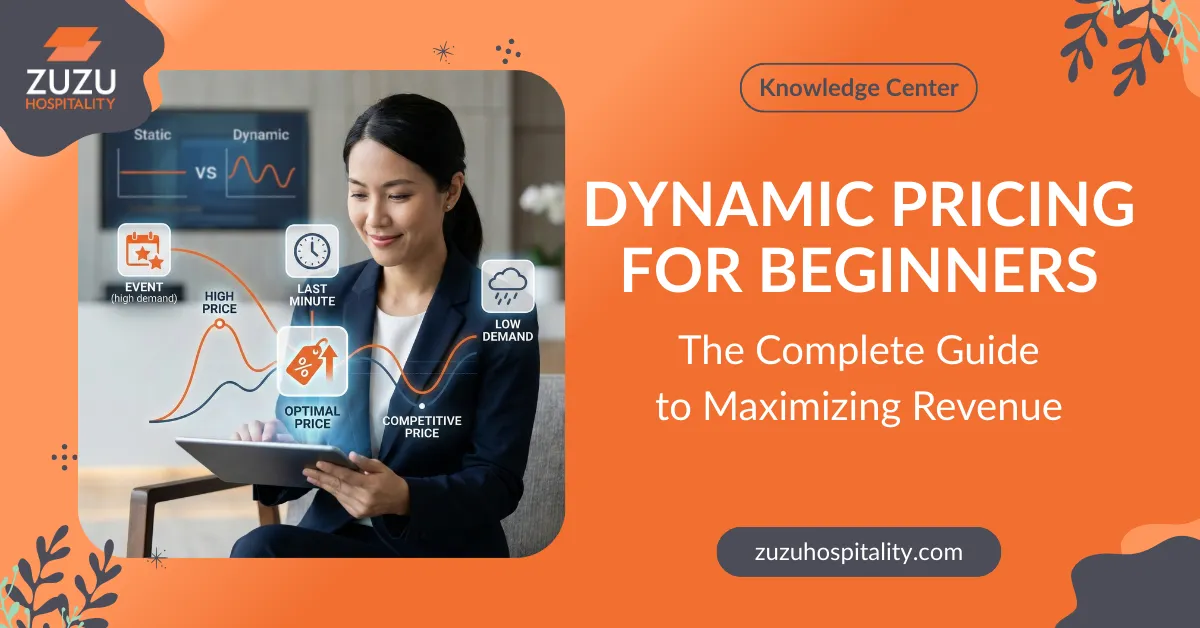
If you've ever wondered why flight prices change every day—or why your competitor charges different rates for the same room on different dates—the answer is dynamic pricing. And if you're not using it for your hotel, you are leaving massive amounts of money on the table.
Think about airlines. A seat on the same flight can cost $200 on Tuesday and $600 on Friday—not because the service changed, but because demand changed. Hotels must apply the same principle to survive and thrive in 2026.
Dynamic Pricing is a revenue management strategy where room rates are flexible and change based on real-time market demand, occupancy levels, competitor pricing, local events, and dozens of other factors. Instead of a flat rate (Static Pricing), dynamic pricing allows you to sell the right room to the right customer at the right time for the highest possible price. [1]
The results speak for themselves: Real-time dynamic pricing powered by AI can increase Average Daily Rate (ADR) by 10-15%, and hotels using sophisticated dynamic pricing strategies see significant RevPAR improvements over static pricing models. [2][3]
This comprehensive guide will show you why dynamic pricing matters, how it works, and how to implement it effectively for your property.
The State of Hotel Pricing in 2026
Understanding the current landscape helps frame why dynamic pricing has become essential:
Market Performance Reality
- RevPAR growth: Modest 0.2-1.5% in 2025-2026 (down from pandemic recovery highs)
- ADR growth: Up 1.0% but below inflation (2.7%), putting pressure on margins
- Occupancy: Down 0.8% as supply increases and competition intensifies
- Key insight: "ADR is growing well below the rate of inflation, which in turn will put more pressure on margins" - STR President Amanda Hite [5]
What this means: Hotels can no longer rely on overall market growth. Revenue optimization through smarter pricing is now the primary path to profitability.
The Shift to Predictive Pricing
2026 is the year pricing moves from reporting to prediction. [6] The most impactful hotel pricing systems are moving beyond historical data and incorporating predictive signals:
- Real-time booking pace and cancellation patterns
- Competitor pricing shifts
- Local events and conferences
- Weather patterns
- Transportation flux (airline flight loads, festival crowding)
- Online sentiment trends
This helps hotels price ahead of demand rather than react after the opportunity has passed.
Static vs. Dynamic Pricing: The Profit Gap
Many independent hotels stick to Static Pricing (one price all year, or simple seasonal adjustments) because it's easy. But "easy" doesn't maximize revenue.
Here is why Dynamic Pricing wins:
| Feature | Static Pricing (Traditional) | Dynamic Pricing (Modern) |
| Price Flexibility | Fixed. Same price regardless of demand, or broad seasonal tiers | Flexible. Changes daily or even hourly based on real-time data [1] |
| Revenue Potential | Capped. You lose money when demand is high by selling out too early at low rates | Maximized. You capture higher rates during peak times and fill rooms during valleys [1][8] |
| Occupancy Management | Passive. Hopes guests will book at your set price | Active. Strategically lowers rates to fill rooms during low demand, raises rates during high demand [1][8] |
| Competitive Response | Slow. Requires manual monitoring and adjustment | Fast. Responds to competitor rate changes in real-time |
| Event Awareness | Manual. Often misses local events or reacts too late | Automated. Factors in concerts, conferences, festivals, holidays |
| Effort Required | Low initially. Set it and forget it | High manually, Low with automation. Requires continuous monitoring OR automated RMS |
| Profitability | Suboptimal. Leaves revenue on table during high demand, struggles to fill during low demand | Optimized. Balances occupancy and ADR to maximize RevPAR |
The Math Behind the Gap
Example scenario - 30-room hotel:
Static Pricing Approach:
- Year-round rate: $150/night
- Annual occupancy: 65%
- Annual room nights: 30 rooms × 365 days × 65% = 7,118 room nights
- Annual revenue: 7,118 × $150 = $1,067,700
Dynamic Pricing Approach:
- Low demand (40% of year): $120/night at 70% occupancy
- Medium demand (35% of year): $165/night at 70% occupancy
- High demand (25% of year): $220/night at 90% occupancy
- Annual occupancy: 73% (increased from filling low-demand periods)
- Annual revenue: $1,248,400
- Additional revenue: $180,700 (+17%)
This calculation is conservative. Hotels implementing sophisticated dynamic pricing often see 20%+ revenue increases in the first year.
How Dynamic Pricing Actually Works: Core Principles
You don't need a PhD in mathematics to understand the fundamentals. Dynamic pricing revolves around Supply and Demand principles with modern data intelligence:
1. High Demand = High Price (Yield Management)
When to raise rates:
- Your hotel is approaching 80%+ occupancy
- Major local events (concerts, conferences, festivals, sports)
- High-demand travel periods (holidays, school breaks)
- Limited rooms remaining for near-term dates
- Competitor rates rising in your market
Why it works: When supply is constrained and demand is high, guests are willing to pay premium prices because they need a room. If you keep your price artificially low, you:
- Sell out too early (missing potential high-value bookings)
- Leave money on the table (every booking could have been $20-50 higher)
- Signal that your property is less valuable than competitors
Real-world impact: A hotel that raises rates by $30/night for 50 high-demand nights generates $45,000 additional annual revenue (30 rooms × $30 × 50 nights).
2. Low Demand = Competitive Price
When to lower rates strategically:
- Occupancy is below 40% for upcoming dates
- Competitors have dropped their rates
- No major events or demand drivers
- Last-minute inventory remains unsold
- Shoulder seasons or slow weekdays
Why it works: An empty room generates $0 revenue. A room sold at $90 (below your ideal rate) still generates $90 plus potential ancillary revenue (F&B, parking, spa). Strategic discounting can:
- Steal bookings from competitors who are too rigid
- Build base occupancy that improves property metrics
- Generate positive reviews and future direct bookings
- Cover variable costs and contribute to fixed costs
Critical note: "Strategic discounting" doesn't mean being the cheapest. It means being competitively priced while maintaining brand value.
3. The "Booking Window" Factor
Dynamic pricing also considers when the booking is made relative to the stay date: [8]
Early Bookings (60-90+ days out):
- Lower rates to secure base occupancy and cash flow
- Builds predictability for operations planning
- Competes for planners who book far in advance
Mid-Range Bookings (14-60 days):
- Moderate rates reflecting current demand forecast
- Adjusts as actual booking pace reveals true demand
- Most bookings occur in this window
Last-Minute Bookings (0-14 days):
- If occupancy is high: Premium rates for urgent bookings (business travelers, event attendees)
- If occupancy is low: Aggressive discounts to fill remaining inventory
- Requires daily or even hourly rate adjustments
4. Segment-Based Pricing
Sophisticated dynamic pricing differentiates by customer segment:
- Business travelers: Less price-sensitive, book closer to arrival, value convenience
- Leisure travelers: More price-sensitive, book further in advance, value experience
- Groups: Volume-based pricing with displacement analysis
- Corporate accounts: Negotiated rates with volume commitments
The AI Revolution in Hotel Pricing (2026)
The pricing landscape has fundamentally changed with AI and machine learning:
Self-Learning Pricing Engines
Legacy RMS (Revenue Management Systems):
- Fixed rules and thresholds set by humans
- Required constant manual adjustments
- Static unless someone rewrote the logic
- Analyzed historical patterns only
AI-Powered RMS:
- Updates itself thousands of times per day
- Learns from booking behavior in real-time
- Adapts to competitor shifts automatically
- Incorporates hundreds of demand signals simultaneously
- Forecasts forward, not just backward
The result: Hotels using AI-powered dynamic pricing can increase ADR by 10-15% through more precise, responsive pricing that captures every opportunity. [2]
Collaborative AI: The 2026 Standard
The first wave of pricing automation promised "hands-off" solutions that never earned real trust. 2026's winning approach is Collaborative AI:
How it works:
- AI handles heavy computational lifting and real-time monitoring
- System learns from revenue manager decisions and preferences
- Human expertise guides strategy, segmentation, and brand positioning
- AI executes tactical pricing consistently across all channels
Why it matters:
- Many independent hotels don't have dedicated revenue managers
- Pricing often falls on GMs or owners who are already stretched thin
- AI provides expert-level execution without requiring full-time specialists
- Revenue managers shift from tactical execution to strategic design
Key insight: "The future of AI hotel pricing is not about removing human judgment. It is about making that judgment easier to execute consistently." [6]
Predictive Demand Signals
Modern systems incorporate signals that were impossible to track manually:
- Weather forecasts: Predicting beach destination demand or conference cancellations
- Airline load factors: Anticipating visitor volume to your city
- Social media sentiment: Detecting buzz around local events
- Search trends: Understanding when people are shopping for your market
- Competitor inventory: Tracking how fast your comp set is selling out
This predictive approach lets hotels price ahead of visible demand curves rather than reacting after opportunities pass.
5 Common Dynamic Pricing Mistakes to Avoid
Implementing dynamic pricing isn't just about changing numbers. Avoid these traps:
Mistake #1: Being the Cheapest
The problem: Trying to undercut all competitors to maximize occupancy.
Why it fails:
- Devalues your brand permanently
- Attracts price-shopping guests who won't return
- Starts a race to the bottom with competitors
- Revenue suffers even if occupancy is high
Better approach: Aim to offer the best value at a competitive price. Communicate your unique selling points (location, amenities, service) to justify your rates.
Mistake #2: Reacting Too Late
The problem: Changing prices after competitors have already captured the market.
Why it fails:
- High-value guests have already booked elsewhere
- You're fighting for remaining low-value demand
- Lost revenue opportunities are gone forever
Better approach: Use predictive demand forecasting and monitor competitor pricing in real-time. Price proactively based on booking pace and forward-looking signals.
Mistake #3: Ignoring Local Events
The problem: Not knowing about a major concert, conference, marathon, or festival in your city.
Why it fails:
- You sell rooms for $120 while neighbors charge $250
- Lost opportunity can equal thousands in a single night
- Guests perceive you as unaware of your market
Better approach: Maintain an event calendar and integrate it into pricing strategy. Subscribe to local tourism bureau updates, convention center schedules, and venue calendars.
Mistake #4: Making Changes Too Infrequently
The problem: Updating prices weekly or only when you remember to check.
Why it fails:
- Miss opportunities as demand shifts daily
- Can't respond to competitor rate changes
- Booking windows are compressed—opportunities pass quickly
Better approach: Daily rate reviews minimum, ideally multiple times per day for near-term dates. This is where automation becomes essential.
Mistake #5: Treating All Channels Equally
The problem: Setting the same rate across direct bookings, OTAs, and wholesale channels.
Why it fails:
- Ignores different commission structures (OTAs charge 15-25%)
- Doesn't incentivize direct bookings
- May violate rate parity agreements unintentionally
Better approach: Set base rates that account for channel costs. Your direct booking rate should be your best value (no commission), OTA rates can be slightly higher to cover their commission, wholesale/group rates negotiated separately.
Implementing Dynamic Pricing: Your Options
You have three realistic paths forward:
Option 1: Manual Dynamic Pricing
How it works:
- Daily review of competitor rates via manual shopping
- Adjust your rates based on occupancy and demand assessment
- Track results in spreadsheets
Pros:
- No software investment required
- Complete control over every decision
- Deep understanding of your market
Cons:
- Time-intensive (1-3 hours daily)
- Prone to human error and biases
- Can't track hundreds of signals
- Vacation and sick days create pricing gaps
- Difficult to be consistent
Best for: Very small properties (under 10 rooms) with owners who enjoy data analysis.
Option 2: Revenue Management System (RMS)
How it works:
- Software platform that analyzes data and recommends/sets prices
- Integrates with your PMS and channel manager
- Uses algorithms to optimize rates
Pros:
- Analyzes far more data than humanly possible
- Consistent execution 24/7
- Responds to market changes in real-time
- Frees up management time
Cons:
- Monthly subscription cost ($200-800+/month depending on property size)
- Learning curve for initial setup
- Still requires human oversight for strategy
Best for: Properties with 20+ rooms that want professional-grade revenue optimization.
Option 3: Managed Revenue Service (RMS + Human Experts)
How it works:
- Combines AI-powered RMS with dedicated revenue management professionals
- Technology handles data analysis and execution
- Human experts set strategy, monitor performance, handle exceptions
Pros:
- Best of both worlds: AI precision + human expertise
- Access to professional revenue managers without hiring full-time
- Strategic guidance for positioning and distribution
- Proactive adjustments for your specific market
Cons:
- Higher investment than RMS-only
- Less direct control (trusting external experts)
Best for: Independent hotels serious about revenue optimization who want expert-level results without building internal expertise.
Measuring Dynamic Pricing Success
Track these metrics to evaluate your pricing strategy:
Primary Metrics
1. RevPAR (Revenue Per Available Room)
- Formula: Total Room Revenue ÷ Total Available Rooms
- Target: Month-over-month growth after implementing dynamic pricing
- Industry benchmark: 0.2-1.5% growth in 2025-2026 market [4]
2. ADR (Average Daily Rate)
- Formula: Total Room Revenue ÷ Rooms Sold
- Target: 10-15% increase with AI-powered dynamic pricing [2]
- Watch for: ADR growing faster than occupancy decline
3. Occupancy Rate
- Formula: Rooms Sold ÷ Total Available Rooms
- Target: Balanced optimization (not maximum occupancy at any price)
- Sweet spot: Usually 70-85% depending on market
Secondary Metrics
4. Pick-up Rate
- How fast are you selling inventory relative to past years?
- Indicates if pricing is optimized for booking pace
5. Pricing Position vs. Comp Set
- Where do your rates sit relative to direct competitors?
- Target: Aligned with your quality/service level
6. Booking Window Distribution
- When are guests booking? (advance vs. last-minute)
- Helps optimize pricing by booking window
7. Channel Mix Revenue
- How much comes from direct vs. OTA vs. other channels?
- Ensures you're not over-reliant on high-commission channels
Understanding Dynamic Pricing Limitations
It's important to have realistic expectations:
What Dynamic Pricing Cannot Do
Cannot fix fundamental problems:
- Poor location or outdated property
- Consistently bad reviews and low ratings
- Terrible service or maintenance issues
- Markets with sustained low demand
Cannot eliminate all revenue volatility:
- Seasonal businesses will still have slow periods
- Economic downturns affect everyone
- Natural disasters or pandemics disrupt all strategies
Cannot replace good operations:
- Pricing optimization works best with strong guest experiences
- Bad reviews will force prices down regardless of strategy
- Operational excellence enables premium pricing
What Dynamic Pricing CAN Do
Maximize revenue from existing demand:
- Capture peak rates during high-demand periods
- Fill rooms that would otherwise sit empty
- Optimize the balance between occupancy and ADR
Provide competitive advantages:
- Respond faster than competitors using static pricing
- Identify opportunities they miss
- Build revenue resilience in challenging markets
Improve decision-making:
- Data-driven insights replace gut feelings
- Understand true demand patterns
- Identify which segments and channels perform best
The 2026 Mandate: Why Dynamic Pricing is No Longer Optional
The hotel industry has reached an inflection point where dynamic pricing is the difference between survival and thriving:
Market realities: [4][5][9]
- ADR growth below inflation squeezes margins
- New supply entering many markets increases competition
- Booking windows fluctuate unpredictably
- Labor costs rising faster than revenue
Technology availability: [2][6]
- AI-powered RMS accessible to independent hotels
- Costs have decreased while capabilities expanded
- Collaborative AI respects human judgment while amplifying capabilities
Guest expectations:
- Travelers understand dynamic pricing (they see it everywhere)
- Price transparency across OTAs makes static pricing uncompetitive
- Guests research across dates looking for best value
Bottom line: "In 2026, focus on contribution margin, not RevPAR alone. Every pricing decision should reflect its flow-through impact to GOP (Gross Operating Profit), not just topline appeal." [9]
Conclusion: The Right Room, Right Time, Right Price
Dynamic pricing is no longer a luxury feature for major chains—it's a fundamental necessity for any hotel that wants to compete effectively in 2026 and beyond.
The evidence is clear:
- 10-15% ADR increase with AI-powered dynamic pricing [2]
- Revenue optimization possible even in flat markets [4][5]
- Competitive advantage through faster, smarter pricing [6]
- Improved profitability by balancing occupancy and rate [9]
Whether you choose manual dynamic pricing, an RMS platform, or a managed service with expert support, the critical step is moving away from static pricing.
The hotels thriving in 2026 are those that embrace data-driven, responsive pricing that adapts to market conditions in real-time. The question is not whether to implement dynamic pricing, but how quickly you can make the transition.
Ready to See Dynamic Pricing in Action?
If you're curious about how dynamic pricing could impact your property's revenue, try our free Dynamic Pricing Simulation Game. Adjust rates based on different scenarios and see how your decisions affect your bottom line.
For hotels ready to implement professional-grade dynamic pricing, ZUZU Hospitality offers an integrated revenue management solution that combines:
- AI-powered dynamic pricing that analyzes market conditions 24/7
- Expert revenue managers who set strategy and monitor performance
- Seamless integration with your PMS and channel manager
- Transparent reporting that shows exactly how pricing decisions impact revenue
The system is designed for independent hotels that want expert-level revenue optimization without hiring full-time specialists.
Book a free consultation to explore how ZUZU's revenue management can help you maximize your property's profitability.
References
[1] SiteMinder. Hotel dynamic pricing: Full guide with examples. Retrieved from https://www.siteminder.com/r/hotel-dynamic-pricing/
[2] Hotel Technology News. (December 2025). How AI Will Rewrite Hotel Revenue Management Systems in 2026 (Jordan Hollander). Retrieved from https://hoteltechnologynews.com/2025/11/how-ai-will-rewrite-hotel-revenue-management-systems-in-2026/
[3] NetSuite. (November 2025). How Dynamic Pricing Can Improve Hotel Revenue. Retrieved from https://www.netsuite.com/portal/resource/articles/business-strategy/hotel-dynamic-pricing.shtml
[4] PwC. Hospitality outlook and AI-driven hotel trends 2026. Retrieved from https://www.pwc.com/us/en/industries/financial-services/asset-wealth-management/real-estate/emerging-trends-in-real-estate-pwc-uli/property-type-outlook/hospitality.html
[5] Hotel Online. Forecasts Are Falling: It's Time to Look Inward and Refine Your 2026 Plan. Retrieved from https://www.hotel-online.com/news/forecasts-are-falling-its-time-to-look-inward-and-refine-your-2026-plan
[6] Hospitality Net. 2026 Hotel Pricing Trends That Will Change Revenue Management Forever (Bobby Marhamat). Retrieved from https://www.hospitalitynet.org/opinion/4130285.html
[7] HFTP. 2026 Hotel Pricing Trends That Will Change Revenue Management Forever. Retrieved from https://www.hftp.org/news/4130285/2026-hotel-pricing-trends-that-will-change-revenue-management-forever
[8] Cloudbeds. The beginner's guide to hotel room price optimization. Retrieved from https://www.cloudbeds.com/articles/hotel-price-optimization/
[9] HotelData.com. (November 2025). Q3 2025 Hotel Industry Performance Data. Retrieved from https://hoteldata.com/reports/q3-2025-profit-report/
Additional Resources
Pricing Trends & Analysis:
- Accio. 2025 Hotel Pricing Trends: Key Shifts & Strategic Insights. https://www.accio.com/business/hotel-pricing-trends
- Accio. 2025 Hotel Price Trends: ADR Growth vs. Occupancy Decline Analysis. https://www.accio.com/business/hotel_price_trends
Revenue Management Insights:
- HotelTechReport. What is Dynamic Pricing in Hotels and Why Does It Matter? https://hoteltechreport.com/news/dynamic-pricing-hotels
- MMC Invest. (August 2025). U.S. Hotel Cap Rates in 2025: Trends, Drivers, and Segment Analysis. https://www.mmcginvest.com/post/u-s-hotel-cap-rates-in-2025-trends-drivers-and-segment-analysis