January 19, 2026
Direct Booking Strategy: How to Reduce OTA Commissions & Boost Profit (2026)
Maximize Profit by Lowering OTA Fees through a Direct Booking Strategy (2026)
Learn how to boost your profits in 2026 by implementing a direct booking strategy to reduce OTA commissions and maximize revenue.
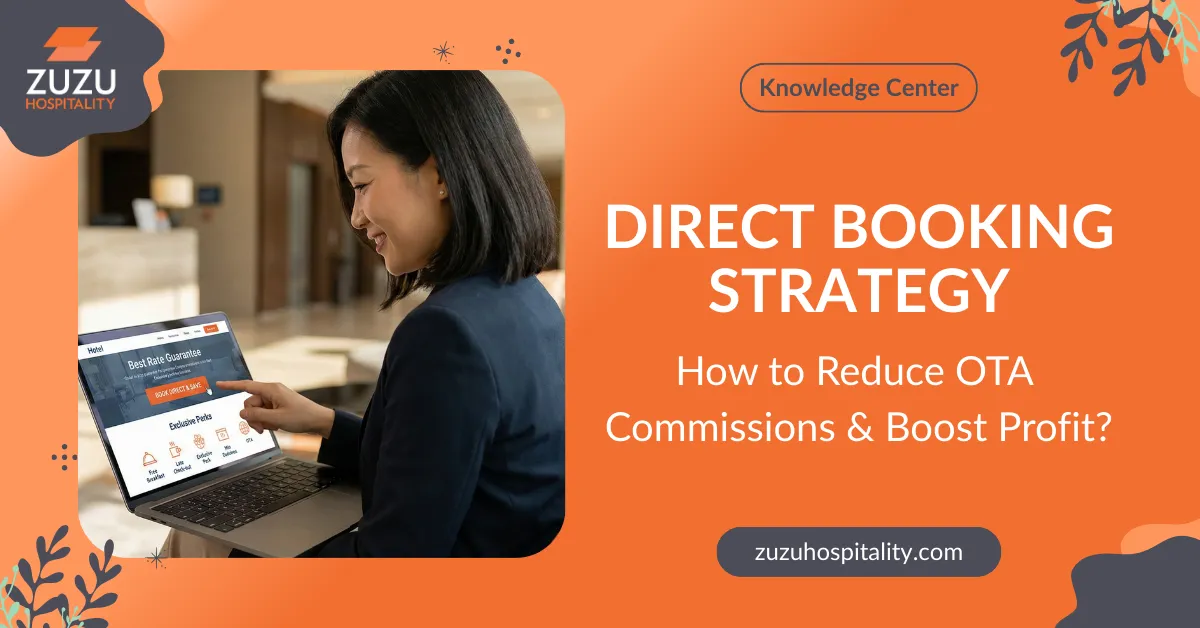
If you are a hotel owner, you know the pain of seeing 15% to 30% of your revenue disappear into commission fees every month. While Online Travel Agencies (OTAs) are great for filling rooms, relying on them 100% is a dangerous strategy for your profit margins. [1]
Direct Booking Strategy is a marketing approach focused on encouraging guests to book directly through your hotel's own channels—website, phone, or social media—bypassing third-party intermediaries. The goal is simple: own the guest, keep the data, and keep the money.
According to recent industry data, 18% of travelers who start their search on an OTA ultimately book directly with hotels, up 3.3 percentage points from previous years as guests seek better control and service. [2] Additionally, direct bookings generate up to 60% higher revenue per booking compared to OTA reservations, as travelers choose higher-value rooms, stay longer, and add extras when booking directly. [3]
This guide will show you how to turn your hotel website from a digital brochure into a high-conversion booking machine.
The "Billboard Effect": Why You Still Need OTAs
Before we declare war on OTAs, let's understand their value. They are not the enemy; they are your marketing partners.
Research from Cornell University identifies a phenomenon called the "Billboard Effect." Multiple studies found that 75% of consumers who booked at a hotel's brand website had visited an OTA in advance of booking directly with the brand. [4][5]
The original 2009 experiment found that hotels listed on Expedia saw a 7.5% to 26% increase in non-OTA reservations (bookings made through other channels) simply from being visible on the platform. [6] A later expanded study analyzing 1,720 transactions found that for each reservation a hotel receives at Expedia, the individual brand website receives between 3 and 9 additional reservations. [7]
What this means: Many travelers discover a hotel on an OTA (like Agoda or Booking.com) but then visit the hotel's own website to check for better rates or more information before booking. In fact, research shows that 65% of direct bookings come from guests who first saw the hotel on an OTA. [8]
The strategy, therefore, is not to leave OTAs, but to capture those "window shoppers" once they land on your website.
Direct Booking vs. OTA Booking: The Profit Breakdown
Why is the shift to direct bookings so critical? It comes down to two things: Profit and Control.
Here is a breakdown of what happens when a guest books direct versus through an OTA:
| Feature | OTA Booking (Third-Party) | Direct Booking (Your Website) |
|---|---|---|
| Commission Cost | High. You pay 15% - 30% per booking [1][9] | Low. ~2-3% (Payment gateway fees) |
| Guest Data | Masked. You often get a generic email (e.g., guest@agoda.com) | Owned. You get real emails for marketing & loyalty [10] |
| Cash Flow | Delayed. Some OTAs pay you weeks after check-out | Immediate. You can collect payment instantly |
| Control | Low. Hard to upsell or change terms | High. You control cancellation policies & upgrades [10] |
| Loyalty | To the Platform. They are Agoda's customers | To You. They are your customers |
| Revenue Per Booking | Lower. Standard room rates, shorter stays | Higher. Guests book premium rooms, stay longer, add extras [3] |
The Real Cost of OTA Commissions
Let's break down the numbers:
Commission rates in 2026: [1][9][11]
- Booking.com: 15% - 18% (higher with promotional features)
- Expedia Group: 15% - 25% (varies by brand and location)
- Agoda: 15% - 25% (higher for preferred partner programs)
- Trip.com: 10% - 25% (depends on property size and location)
Example calculation:
- Room rate: $200/night
- OTA commission at 20%: $40 per booking lost
- For a 30-room hotel with 60% occupancy: 18 rooms × 30 days × $40 = $21,600/month in commission fees
- Annual OTA commission cost: $259,200
Direct booking costs:
- Payment gateway fee: 2-3%
- For the same $200 booking: $4-6 per booking
- Same scenario: 18 rooms × 30 days × $5 = $2,700/month
- Annual direct booking cost: $32,400
- Potential annual savings: $226,800 by shifting to direct bookings
The Direct Booking Trend: What's Happening in 2026
The hospitality industry is experiencing a significant shift toward direct bookings:
Industry Statistics: [2][3][12][13]
- 18% of travelers who start their search on an OTA ultimately book directly (up 3.3 percentage points)
- Direct bookings generate up to 60% higher revenue per booking than OTA reservations
- Direct digital channels projected to surpass OTAs by 2030, generating $409 billion in gross bookings vs. $333 billion from OTAs
- Hotels' direct websites are becoming the primary booking channel, with the gap widening month over month
- 26% of travelers now start their hotel search on Booking.com (overtaking Google for the first time), but many still convert to direct bookings
Booking Window Trends: [13][14]
- Average booking window: 32 days in advance (increasing for the fourth consecutive year)
- Cancellations: Below 20% (travelers are more confident and committed)
- 65% of travelers plan vacations 1-3 months ahead, and 68% book accommodations within 1-2 months
What This Means: Travelers are researching longer, booking with more confidence, and increasingly willing to book direct when given compelling reasons to do so.
3 Essential Tools to Drive Direct Bookings
You cannot simply ask guests to "Book Direct" if the process is difficult. To compete with the tech giants, you need the right tools:
1. High-Converting Hotel Website
Your website is your digital storefront. If it is slow, not mobile-friendly, or hard to navigate, guests will bounce back to the OTA app.
Critical requirements: [10][15]
- Mobile-first design: Over 50% of online travel bookings happen on mobile devices [13]
- Fast loading speed: Pages that load in 2 seconds or less dramatically reduce bounce rates
- Professional photography: High-quality images that showcase your property's best features
- Clear value proposition: Immediately visible unique selling points
- Trust signals: Reviews, certifications, security badges
- Easy navigation: Clear path to booking in 3 clicks or less
Real-world impact: A well-optimized, mobile-responsive hotel website significantly increases conversion rates compared to outdated or desktop-only sites.
2. Integrated Booking Engine
This is the most critical tool. A Booking Engine is the software that processes the reservation on your site. It must be integrated with your PMS so that rates and availability are live. [15]
Must-have features:
- Real-time availability: Synced with your PMS and channel manager
- Instant confirmation: Automated booking confirmation emails
- Secure payment processing: PCI-compliant payment gateway
- Mobile optimization: Seamless experience on all devices
- Multi-language support: Serve international guests
- Rate flexibility: Display packages, promotions, seasonal rates
- Guest account creation: Enable repeat booking convenience
Critical insight: If a guest has to fill out a "contact form" to ask for a room, you have already lost the sale. The booking process should be as friction-free as possible.
3. Google Hotel Ads (Meta Connectivity)
When travelers search for your hotel on Google, they see a price comparison list on the right side (Google Maps/Travel). If your "Official Site" price does not appear there, OTAs will steal the click. [16]
How it works:
- Google displays hotel rates from multiple sources side-by-side
- Travelers can compare your direct rate against OTA rates
- If your direct rate is competitive (at or below OTA rates), you capture the booking
- Average cost: 8-12% of booking value (still lower than OTA commissions)
Using Google Hotel Ads allows your direct rate to compete right alongside Booking.com and Agoda in search results, ensuring you don't lose bookings by default. [16]
Proven Tactics: How to Make Guests Book Direct
Once you have the tools, use these tactics to seal the deal:
1. Best Rate Guarantee
Make it crystal clear that your website offers the lowest price. If an OTA is cheaper (due to a rate disparity), you will lose the booking. [10]
Implementation:
- Prominent "Best Rate Guarantee" badge on your homepage
- Explain your price match policy clearly
- If a guest finds a lower rate elsewhere, match it and give a discount (e.g., additional 10% off)
- Ensure rate parity: your direct rate should match or beat OTA rates
2. Exclusive Perks for Direct Bookers
Give direct bookers something OTAs cannot offer. Value-adds are often more powerful than small discounts. [10][15]
Effective incentives:
- Free breakfast
- Room upgrade (subject to availability)
- Late check-out or early check-in
- Free Wi-Fi (if not standard)
- Welcome drink or amenity
- Spa credit or on-site dining discount
- Free parking
- Flexible cancellation policy
Why this works: Travelers are willing to pay similar rates for meaningful added value that enhances their stay experience.
3. Seamless, Friction-Free Booking Process
Ensure your booking engine allows guests to secure a room in 3 clicks or less. Friction kills conversion. [15]
Best practices:
- Minimize form fields (collect only essential information)
- Enable guest accounts for returning visitors
- Offer multiple payment options
- Display total price upfront (no hidden fees)
- Provide instant confirmation
- Send automated confirmation emails
Stat to remember: Studies show that for every additional step in the booking process, conversion rates drop significantly.
4. Leverage Social Proof and Reviews
Display positive reviews prominently on your website. Reviews are among the most powerful tools for establishing trust and encouraging direct bookings. [8]
Strategies:
- Showcase recent highly-rated OTA reviews on your homepage
- Feature testimonials from past guests
- Display aggregate ratings (e.g., "4.8/5 based on 523 reviews")
- Include photos from satisfied guests (with permission)
5. Retargeting and Email Marketing
Retargeting ads are powerful tools that keep your hotel front-of-mind for guests who found you on an OTA but didn't immediately book. [8]
Effective approaches:
- Facebook and Instagram retargeting campaigns
- Google Display Network remarketing
- Email campaigns for past guests with exclusive offers
- Abandoned cart recovery emails for incomplete bookings
Data point: Email marketing to previous guests can dramatically increase conversion rates and maximize revenue earned via your direct channel.
6. Loyalty Programs
Create a simple loyalty program that rewards repeat direct bookers. [17]
Program ideas:
- Points per stay redeemable for free nights
- Member-only rates or exclusive promotions
- Birthday or anniversary perks
- Tiered benefits (Bronze, Silver, Gold)
Why it works: US travelers place the highest value on loyalty programs, making them ideal for relationship-based marketing. Building a loyal customer base reduces OTA dependency. [2]
Understanding the Challenges: Direct Booking Isn't Easy
While direct bookings are more profitable, it's important to understand the challenges:
Marketing Costs
OTAs spend billions on advertising to drive traffic to their platforms. For example, Expedia spent $1.65 billion USD in Q1 2024 alone on advertising. [1]
To compete, you need to invest in:
- SEO and content marketing
- Google Ads and metasearch campaigns
- Social media marketing
- Email marketing infrastructure
- Website maintenance and optimization
Key insight: While OTA commissions are high, they do provide value in terms of massive marketing reach. Your direct booking strategy must account for the cost of acquiring guests through your own channels.
Brand Recognition Gap
Independent hotels face a significant challenge: travelers trust familiar OTA brands. Booking.com processes over 1.5 million hotel nights every day and has 50 million verified reviews. [18]
Your strategy:
- Build trust through professional website design
- Showcase your own reviews prominently
- Offer flexible cancellation policies to reduce booking risk
- Provide excellent customer service to generate word-of-mouth
Technology Investment
Building an effective direct booking channel requires investment in:
- Professional website development
- Integrated booking engine
- Channel manager (to maintain OTA presence)
- Property Management System (PMS)
- Payment processing infrastructure
- Analytics and tracking tools
The upside: While there's an initial investment, the long-term ROI from reduced commissions makes it worthwhile for most properties.
The Balanced Distribution Strategy
The most successful hotels don't abandon OTAs—they optimize the mix.
Recommended approach:
Use OTAs for:
- Discovery and visibility (the billboard effect)
- Reaching new markets and international travelers
- Filling rooms during low-demand periods
- Competing in markets where you lack brand recognition
Focus direct bookings for:
- Repeat guests who know your brand
- Local and regional travelers
- Corporate bookings and group reservations
- High-value bookings where commission savings are substantial
Target distribution mix:
- Goal: 40-60% direct bookings, 40-60% OTA bookings
- Reality: Most independent hotels currently: 20-30% direct, 70-80% OTA
- Path forward: Gradual shift toward direct through sustained marketing efforts
Measuring Success: Key Metrics to Track
To understand if your direct booking strategy is working, monitor these metrics:
1. Direct Booking Percentage
- Total direct bookings ÷ total bookings
- Track monthly trends
2. Website Conversion Rate
- Bookings ÷ website visitors
- Industry benchmark: 2-5%
3. Cost Per Acquisition (CPA)
- Marketing spend ÷ number of direct bookings
- Compare to OTA commission cost
4. Revenue Per Booking
- Average revenue from direct bookings vs. OTA bookings
- Direct should be higher (longer stays, upgrades, extras)
5. Repeat Guest Rate
- Percentage of guests who book directly a second time
- Strong indicator of loyalty program effectiveness
Conclusion: Building Your Direct Booking Strategy
Reducing OTA commissions doesn't mean deleting your OTA listings. It means finding a healthy balance where OTAs bring you new guests, and your Direct Booking Strategy keeps them coming back.
Key takeaways:
- OTAs are marketing partners, not enemies—use the billboard effect
- Direct bookings are more profitable: Save 15-30% in commissions per booking
- Travelers are shifting to direct: 18% who start on OTAs convert to direct bookings
- Investment required: Professional website, booking engine, and ongoing marketing
- Best approach: Balanced distribution strategy combining OTA reach with direct booking profitability
The hotels that thrive in 2026 are those that master both channels: leveraging OTA visibility while converting as many bookings as possible to their own direct channels.
Ready to Increase Your Direct Bookings?
If you're looking for a comprehensive solution to boost your direct booking strategy, ZUZU Hospitality offers an integrated platform designed specifically for independent hotels.
ZUZU's direct booking solution includes:
- High-performance website optimized for conversions
- Integrated booking engine with real-time availability
- Full PMS integration for seamless operations
- Channel manager connectivity to maintain OTA presence while maximizing direct bookings
- Google Hotel Ads integration for metasearch visibility
The platform is designed to help you capture demand across all channels while maximizing profitability from direct bookings.
Book a free consultation to explore how ZUZU can help you reduce OTA dependency and increase profit margins.
References
[2] SiteMinder. (November 2025). Latest Trends in the Hotel Industry for 2026: Global Booking Data. Retrieved from https://www.siteminder.com/r/latest-trends-in-hotel-industry/
[3] SiteMinder. (March 2025). SiteMinder reveals revenue up to 60% higher from a direct booking. Retrieved from https://www.siteminder.com/news/siteminder-hotel-booking-trends-2025/
[4] Cornell University. (April 2011). Search, OTAs, and Online Booking: An Expanded Analysis of the Billboard Effect (Chris Anderson). Retrieved from https://ecommons.cornell.edu/handle/1813/71017
[5] Cornell University. (April 2017). The Billboard Effect: Still Alive and Well (Saram Han & Chris Anderson). Retrieved from https://ecommons.cornell.edu/items/cc99c641-5795-4e66-b35b-9795385c6f52
[6] Cornell University. (October 2009). The Billboard Effect: Online Travel Agent Impact on Non-OTA Reservation Volume (Chris Anderson). Retrieved from https://ecommons.cornell.edu/handle/1813/71015
[7] Cornell University. (April 2011). Cornell Study Shows Promotion Effect of Online Travel Sites. Retrieved from https://sha.cornell.edu/about/news-and-publications/news/newsdetails.html?id=783
[8] Otamiser. What Is the Billboard Effect and How Can It Increase Hotel Direct Bookings? Retrieved from https://www.otamiser.com/blog/what-is-the-billboard-effect-and-how-can-it-increase-hotel-direct-bookings
[9] Preno. (September 2025). How Much Commission Does Airbnb, Expedia and Booking.com Take (+ Others). Retrieved from https://prenohq.com/blog/ota-commission-rates-expedia-booking-com-more/
[10] SiteMinder. Hotel direct booking website. Retrieved from https://www.siteminder.com/r/hotel-direct-booking-website/
[11] Heads On Pillows. (June 2025). Hotel Direct Booking vs OTA 2025: All You Need to Know. Retrieved from https://headsonpillows.com/direct-booking-vs-ota/
[12] HITEC. 3 Emerging Booking Trends You Can't Ignore in 2025 (Mark Lewis-Brown). Retrieved from https://www.hitec.org/news/4127264/3-emerging-booking-trends-you-cant-ignore-in-2025
[13] SiteMinder. (June 2025). SiteMinder's Hotel Booking Trends. Retrieved from https://www.siteminder.com/hotel-booking-trends/
[14] AllTopHotels. (June 2025). Predictable Booking Trends in 2025: A Game-Changer for Hotels. Retrieved from https://www.alltophotels.com/2025/06/26/predictable-booking-trends-in-2025-a-game-changer-for-hotels/
[15] Little Hotelier. Best direct booking tools for your small hotel. Retrieved from https://www.littlehotelier.com/blog/learn-about-tech/direct-booking-tools/
[16] SiteMinder. Google Hotel Ads: Your ultimate guide. Retrieved from https://www.siteminder.com/r/guide-google-hotel-ads/
[17] Qualtrics. New consumer insights reveal hotel booking trends and loyalty patterns. Retrieved from https://www.qualtrics.com/articles/customer-experience/new-consumer-insights-reveal-hotel-booking-trends-and-loyalty-patterns/
[18] SmartHotelAI. Top 9 Online Travel Agents (OTAs) in 2025. Retrieved from https://www.smarthotelai.com/blog-posts/top-9-online-travel-agents-otas-in-2025
Additional Resources
Industry Research:
- D-EDGE. (April 2025). 2025 Hotel Direct Distribution Report: Unlocking ROI and reducing costs in a shifting digital landscape. https://www.d-edge.com/2025-hotel-direct-distribution-report/
- ProStay. (August 2025). Hotel Booking Statistics: 2025 Market Insights and Trends. https://www.prostay.com/blog/hotel-booking-statistics-2025-market-insights-and-trends/
Strategy Guides:
- Little Hotelier. Hotel direct booking: Ultimate how-to guide. https://www.littlehotelier.com/blog/increase-your-revenue/the-secrets-to-getting-more-direct-bookings-for-your-small-hotel/
- HotelTechReport. Free download the Hotel Distribution Technology Chart 2025/2026. https://hoteltechreport.com/resources/revenue-management/reports/channel-managers/the-hotel-distribution-technology-20252026-chart
OTA Market Analysis:
- The Hotel Blueprint. (October 2025). OTA Market Snapshot 2025: Strategic Shifts, Emerging Trends, and Industry Impact. https://thehotelblueprint.com/ota-market-snapshot-2025-strategic-shifts-trends/
- Lighthouse. (May 2025). The independent hotelier's quick guide to major OTAs. https://www.mylighthouse.com/resources/blog/independent-hotels-guide-major-otas